


The Sociological Imagination

×
- Prijs:
- € 14,99
- Auteur:
- C. Wright Mills
- Uitgever:
- Oxford University Press
- Type boek:
- E-book
- Editie:
- 40
- Gewicht:
- 199 gram
- EAN:
- 9780199756346
- ISBN:
- 9780199756346
- Conditie:
- Nieuw
- Beschrijving:
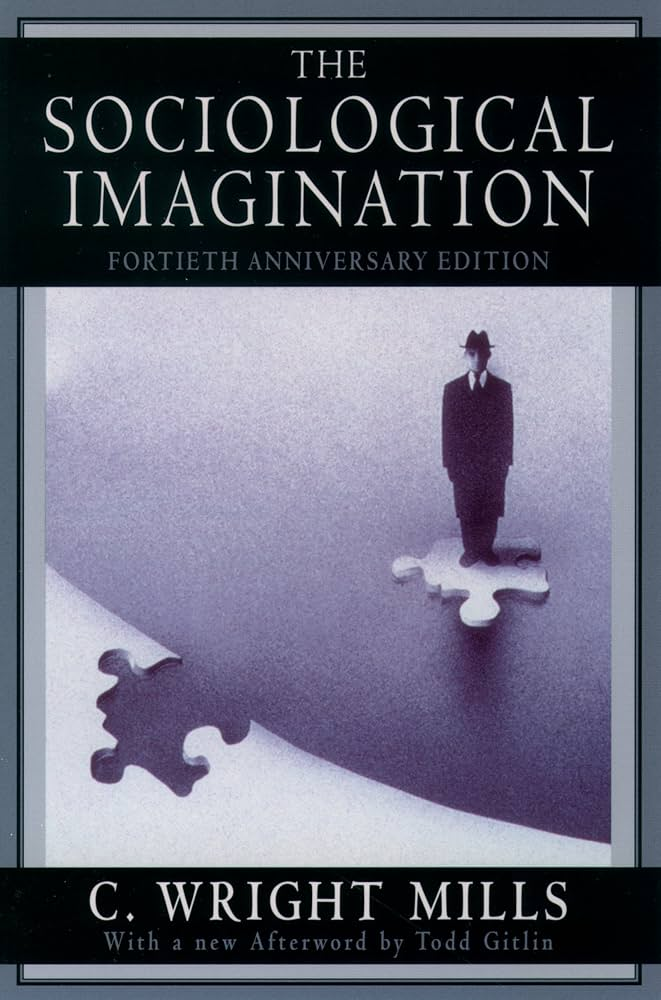
The Sociological Imagination – C. Wright Mills
Originally published in 1959, The Sociological Imagination by legendary Columbia University Professor of Sociology C. Wright Mills remains one of the most influential and widely cited works in modern social science. Serving as both a foundational text and a rigorous critique of the mid-20th-century academic establishment, this classic book sets forth an enduring vision for how social science should be pursued.
Defining the Sociological Imagination: The Core Concept
The central premise of Mills' work is the introduction of the sociological imagination—a cognitive framework and sociological vision that enables individuals to comprehend the intimate interplay between biography and history within social structures.
The book argues that a comprehensive social analysis must bridge the gap between two distinct dimensions of human reality:
- Personal Troubles of Milieu: Private problems experienced by an individual within their immediate social and interpersonal environments.
- Public Issues of Social Structure: Broader systemic contradictions, institutional crises, and structural transformations that transcend the individual and affect society as a whole.
By linking these personal and historical dimensions, the sociological imagination empowers citizens and scholars to recognize that seemingly isolated individual hardships are often rooted in macroeconomic and institutional shifts.
A Critique of Ascendant Schools of Sociology
Upon its initial publication, The Sociological Imagination was hailed as a cogent, hard-hitting critique of the dominant academic paradigms in the United States. Mills explicitly took issue with the ascendant schools of sociology during his era, targeting:
1. Grand Theory: Heavily criticized for its abstract, convoluted language that detached sociological thought from empirical reality.
2. Abstracted Empiricism: Criticized for its over-reliance on rigid statistical methodologies devoid of substantial historical context or social critique.
In contrast to these bureaucratic tendencies, Mills called for a humanist sociology—a discipline deeply committed to democracy, human freedom, and the unification of social, personal, and historical contexts.
The Fortieth Anniversary Edition: Amitai Etzioni’s Introduction
To maintain contemporary relevance, the widely studied fortieth anniversary edition available on Amazon features a lucid, analytical introduction by leading sociologist Amitai Etzioni.
Etzioni—a distinguished University Professor at George Washington University and former senior White House adviser—contextualizes Mills' legacy for the modern era. In his introductory essay, Etzioni evaluates the evolution of social analysis since 1959, exploring how contemporary macro-sociology has progressed, adapted, or diverged from Mills' foundational humanist framework.
Legacy and Impact in Contemporary Social Science
Decades after its inception, The Sociological Imagination continues to provide rich food for thought, remaining a mandatory component of university curricula worldwide. It stands as an indispensable intellectual guide for researchers, students, and critical thinkers aiming to decode the complex structural forces shaping contemporary global society.