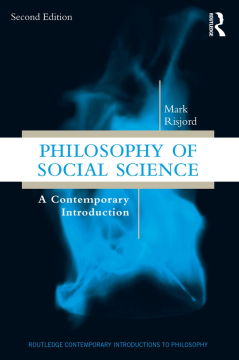
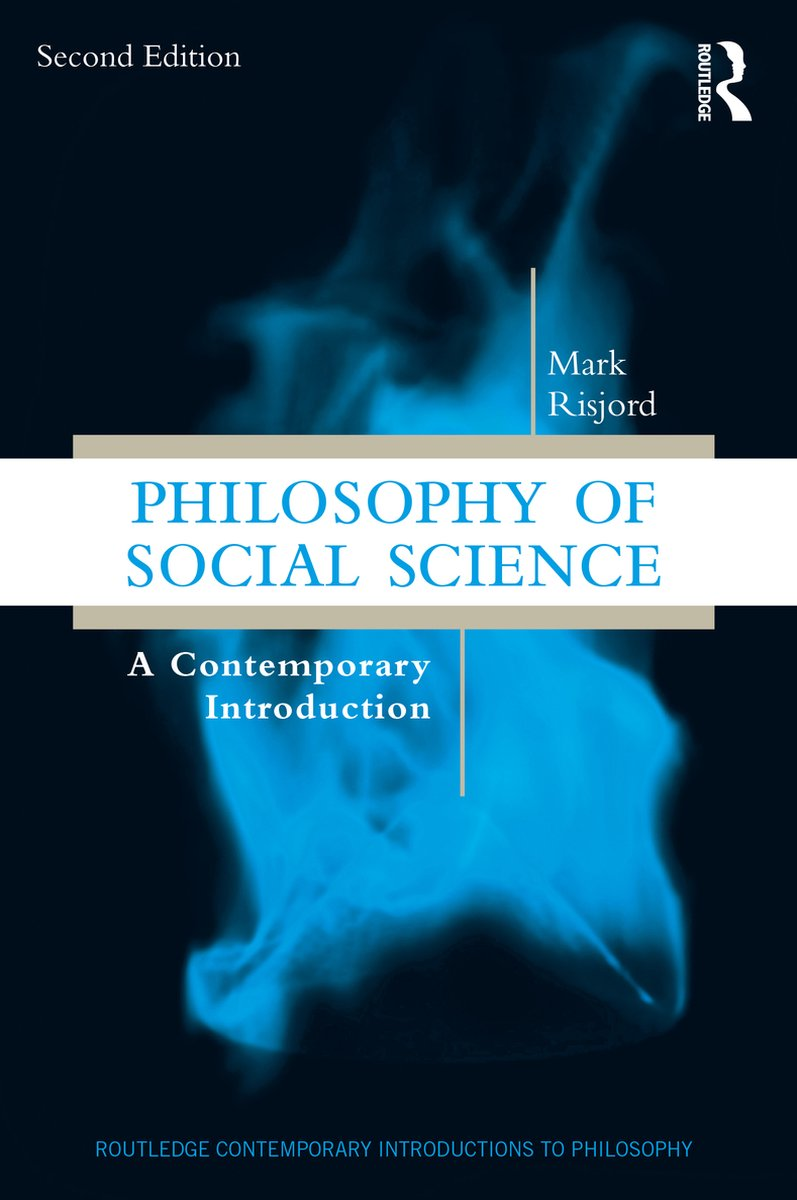
Philosophy of Social Science
×
×
- Prijs:
- € 55,89
- Auteur:
- Mark Risjord
- Uitgever:
- Routledge
- Type boek:
- Paperback
- Editie:
- 2
- Gewicht:
- 506 gram
- EAN:
- 9781032075860
- ISBN:
- 9781032075860
- Conditie:
- Nieuw
- Beschrijving:
Philosophy of Social Science - A Contemporary Introduction
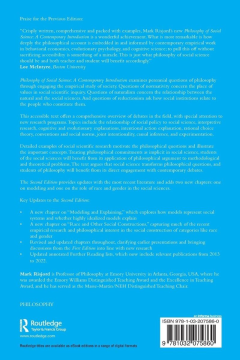
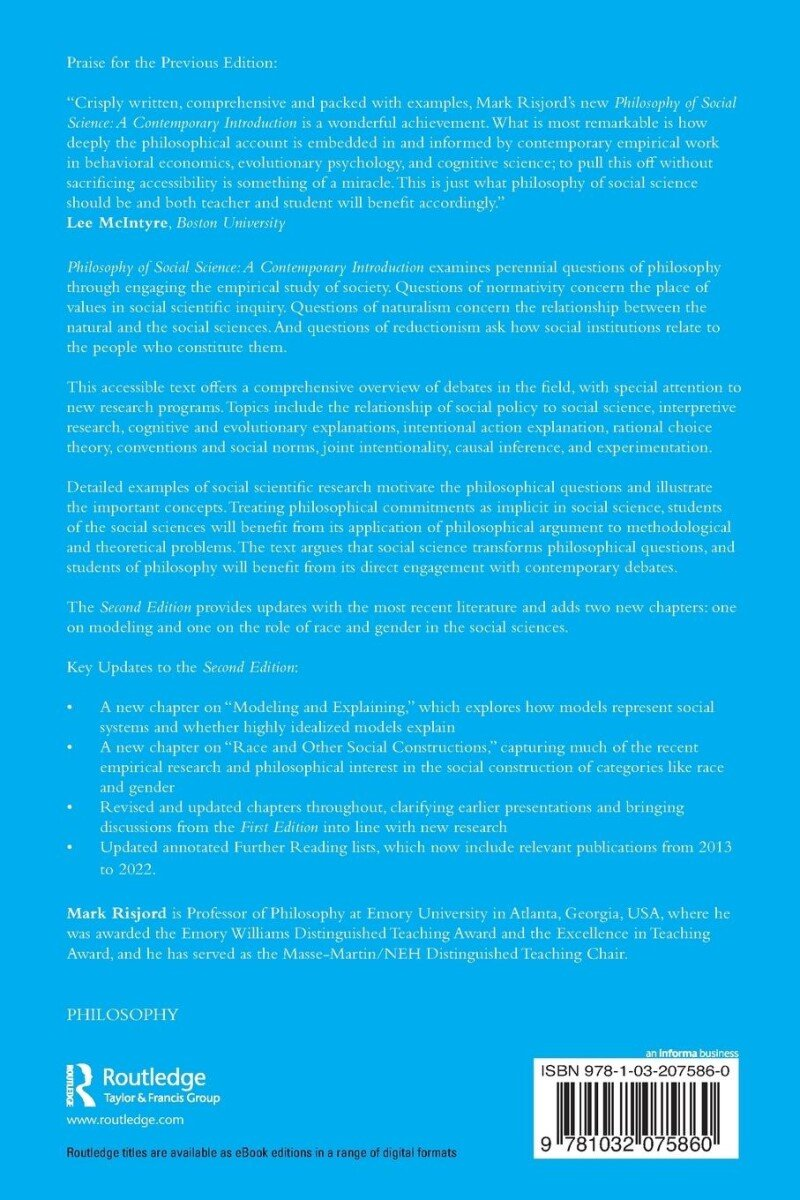
Mark Risjord’s seminal textbook, Philosophy of Social Science: A Contemporary Introduction (Second Edition, ISBN: 9781032075860), provides a rigorous yet highly accessible framework for understanding the conceptual foundations of social scientific inquiry. By continuously bridging the gap between abstract philosophical arguments and empirical sociological, anthropological, and psychological research, Risjord demonstrates that philosophical commitments are not merely external critiques but are deeply embedded within the methodology of the social sciences. The text serves as a vital resource for scholars and students alike, illustrating how modern empirical research dynamically reshapes traditional philosophical questions.
The Tripartite Core of Social Philosophy: Naturalism, Normativity, and Reductionism
At the heart of Risjord’s investigation are three perennial axes of philosophical debate that govern how researchers approach the social world:
• The Problem of Naturalism: This debate interrogates the epistemological relationship between the natural sciences and the social sciences. It questions whether the methodologies of physics, chemistry, and biology—such as strict causal law formulation and controlled experimentation—can or should be applied to the study of human societies, or whether human action requires an entirely distinct interpretative framework.
• The Problem of Normativity: This domain explores the intricate role of values, ethical constraints, and social policy within scientific investigation. Risjord examines how social scientific inquiry can maintain objectivity while investigating normative frameworks, and addresses the extent to which social research should actively inform or critique public policy.
• The Problem of Reductionism: This ontological question asks how social institutions, structures, and macro-level phenomena relate to the individuals who constitute them. It contrasts methodological individualism, which posits that social facts must be reduced to the intentional actions of individuals, with holistic perspectives that view social entities as possessing independent causal power.
Theoretical Frameworks and Contemporary Methodology
Risjord comprehensively maps the diverse landscape of contemporary research programs, analyzing how different paradigms explain intentional action and collective behavior. The text contextualizes several prominent theoretical models:
• Interpretive Research and Intentional Action: Exploring how human behavior is saturated with meaning, this framework focuses on understanding the reasons behind actions rather than merely identifying external causes.
• Rational Choice Theory, Conventions, and Social Norms: This approach models individuals as rational actors optimizing utility, while investigating how collective equilibrium states solidify into social norms and conventions.
• Cognitive, Evolutionary, and Joint Intentionality Explanations: By integrating insights from evolutionary biology and cognitive science, Risjord examines the biological underpinnings of human cooperation and the capacity for shared, collective intentionality.
• Causal Inference and Experimentation: The text evaluates the shifting boundaries of social science methodology, focusing on how researchers establish robust causal claims through statistical inference, case studies, and field experiments.
Key Updates and Critical Expansions in the Second Edition
The second edition of Risjord's text introduces crucial updates that bring the philosophical discourse into alignment with modern scholarly literature spanning from 2013 to 2022.
Modeling and Explaining in Social Systems
A significant addition to this edition is a dedicated chapter examining the role of scientific modeling. Social scientists frequently rely on highly idealized, abstract simulations to represent complex societal dynamics. Risjord investigates the epistemic validity of these models, questioning whether highly idealized frameworks that deliberately simplify reality can genuinely provide explanatory power, or if they merely serve as heuristic tools.
Race, Gender, and Social Constructionism
Reflecting the major contemporary shift toward critical theories, the second edition introduces a profound exploration of social categories in the chapter "Race and Other Social Constructions." This section interrogates the ontological status of race and gender, synthesizing recent empirical data with philosophical nominalism and realism. Risjord analyzes how categories that lack a biological foundation can still function as powerful, objective social realities with tangible causal consequences.
Methodological Synergy Between Philosophy and Social Science
Ultimately, Risjord advances the compelling thesis that the relationship between philosophy and social science is bidirectional. While social scientists benefit from exposing and refining the philosophical assumptions underlying their theoretical frameworks, philosophers must directly engage with empirical findings to prevent their concepts from becoming obsolete. By analyzing real-world research paradoxes, Philosophy of Social Science shows that the empirical study of society actively transforms our understanding of knowledge, causation, and reality itself.